Our History as Advocates
Canada needs more employee ownership. The $10M capital gains exemption is now permanent, but permanence is just the beginning. EOC’s work continues: making employee ownership more accessible, helping business owners find the right model for their situation, and ensuring the policy environment keeps pace with the growing demand for Canadian-owned, worker-driven succession.

History of advocacy at Employee Ownership Canada
Employee Ownership Canada has been advancing employee ownership for decades. What began as early efforts to educate policymakers has grown into a national movement that helped bring Employee Ownership Trusts to life in 2024.
Early Advocacy (1990s–2015)
- In the 1990s, Perry Phillips (founder of the ESOP Association of Canada) held multiple high-level meetings with federal officials to encourage ESOP-friendly legislation, inspired by successful U.S. models.
- While these early efforts did not lead to immediate legislative change, they laid essential groundwork for later momentum.
- Through the early 2000s, the ESOP Association continued educating advisors, business owners, and government about employee ownership.
Renewed Momentum and Coalition Building (2020–2023)
- In 2020, Social Capital Partners (SCP) published Building an Employee Ownership Economy (updated in 2022), which helped spark a new wave of national attention.
- Following Budget 2021, the federal government began formally researching employee ownership models.
- Major business and nonprofit leaders, including BMO, Rewrite Capital Partners, Friesens, Raise Recruiting, and Juno College, joined the effort.
- SCP and these partners formed the Canadian Employee Ownership Coalition (CEOC) in January 2023, which quickly grew to nearly 100 leaders advocating for policy change.
Legislative Breakthrough (2024)
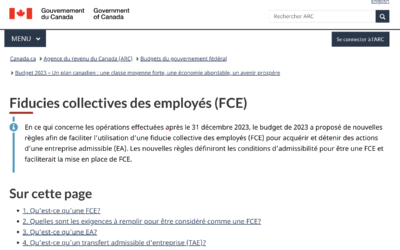
- In summer 2024, the federal government passed legislation enabling Employee Ownership Trusts (EOTs) in Canada.
- The legislation also introduced a targeted $10M capital gains tax incentive to encourage transitions to EOTs and worker co-operatives.
- This represented a landmark achievement for the employee ownership movement.
Ongoing Advocacy (2024–Present)
Employee Ownership Canada continues to advocate for
- Reducing technical barriers so more business owners can access EO models
- Ensuring legislation remains practical, accessible, and aligned with best practices
EOC remains committed to advancing employee ownership policies that strengthen Canadian businesses, communities, and economic resilience.
How We Advocate
Employee Ownership Canada fights for more employee ownership by:
-
Meeting with legislators at the federal and provincial level
-
Submitting proposals to government for new or adjusted policies
-
Responding to proposed government legislation
-
Building awareness among important stakeholders in the Canadian economy
-
Helping aligned stakeholders advocate for employee ownership
-
Writing editorials in prominent newspapers
-
Promoting success stories from Canada and other countries
EOC has a strong track record of working with governments to achieve great outcomes for the employee ownership movement.
EOC’s Current Focus
Improving the ability of business owners to access the tax incentive by reducing red tape and eliminating technical barriers