Advocacy
Employee Ownership Trusts: A Canada-Strong Solution
Canada needs more employee ownership
Canada’s economy is at a pivotal moment. As business owners retire, succession decisions will shape Canadian ownership, worker opportunity, and economic resilience in communities for decades to come.
- Employee Ownership Trusts keep businesses Canadian-owned
- They empower workers and support long-term growth
- Permanence of the EOT tax incentive is essential to scaling this solution
KEY FACTS: WHY EMPLOYEE OWNERSHIP MATTERS NOW
Succession is a national economic issue
- Canada is entering a historic business succession wave.
- More than $2 trillion in small and medium-sized business assets are expected to change hands over the next decade, as 75 to 80 percent of Canadian small business owners plan to retire or sell within ten years.
- Only a small fraction have formal succession plans.
- Poorly managed succession risks business closures, job losses, and reduced productivity across the economy.
Businesses are being sold to third-parties because it is easier, not because it is better
- When viable succession options are limited, business owners often default to third-party or foreign buyers who can offer immediate liquidity.
- These sales may solve a short-term problem for owners but can result in decision-making and wealth moving out of Canada, weakening long-term economic sovereignty.
Employee Ownership Trusts keep businesses and wealth in Canada
- Every sale to an Employee Ownership Trust keeps a business Canadian-owned.
- EOT-owned companies are significantly less likely to fail and tend to remain rooted in their communities, preserving jobs, local investment, and economic stability.
EOTs work because selling owners are supported
- Selling to an EOT requires owners to take on additional complexity and risk. Transactions are financed over time using company cash flow, often with seller financing.
- International experience shows that EOTs only scale when owners are supported through meaningful tax incentives that recognize this risk.
- Both the United States and the United Kingdom have permanent incentives in place, and both have built large, successful employee ownership sectors as a result.
The right decision for Canada is permanence
- Canada’s current EOT capital gains tax exemption is temporary and set to expire at the end of 2026.
- Market evidence already shows that this limited timeline has discouraged adoption, even as interest grows.
- Permanence is required for employee ownership to move from a niche option to a mainstream succession pathway.
WE'RE TAKING ACTION
We called on business leaders, aligned organizations, and Canadians across the country to join us in urging the government to make the Employee Ownership Trust capital gains tax exemption permanent.
The response demonstrated strong leadership, commitment, and momentum from across the ecosystem.
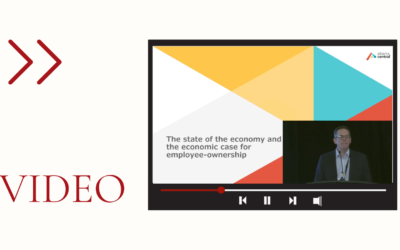
Together, we issued a letter signed by CEOs, presidents, and leaders of some of Canada’s most respected companies. We invited Canadians from all backgrounds to add their voices by signing our open letter calling for government action. And we stood alongside the Canadian Worker Co-operative Federation and Co-operatives and Mutuals Canada to reinforce this call for timely action ahead of the Spring Economic Statement.
These collective efforts are below.


Additional Advocacy Priorities
EOC has advocated over the past year for technical amendments to the EOT legislation in order to address key concerns raised by business owners and advisors. As a result, some of those concerns are poised to be addressed imminently through the passage of Bill C-15. These amendments will strengthen the regulatory foundation of EOTs in Canada and help ensure wider adoption.
We will continue to pursue reduced technical and administrative barriers to EOT adoption to ensure employee ownership legislation remains practical, accessible, and aligned with international best practices.
In addition to technical amendments, The EOC is assessing the current state of employee ownership in Canada to identify broader areas of policy opportunity. One area identified by the sector so far relates to the requirements for change in control as part of a sale to an EOT. The EOC believes this is an area that requires a closer look and will be asking the government to commit to reviewing the provisions in dialogue with our sector.
MORE EVIDENCE THAT EMPLOYEE OWNERSHIP DELIVERS
- Employee ownership has delivered strong results in peer economies.
The United States has more than 6,000 employee-owned companies, generating over $2 trillion USD in worker wealth. The United Kingdom has nearly 3,000 employee-owned companies and more than 250,000 employee-owners.
- Employee-owned companies perform well over time.
Research from the U.S. and U.K. shows higher productivity, stronger growth, and improved resilience during economic downturns compared to peer firms.
- Employee ownership strengthens communities.
Businesses that remain locally owned are more likely to retain jobs, maintain a stable tax base, and reinvest in their communities. Economic development research consistently shows that most new jobs and capital investment come from businesses that already exist in a community, not from new arrivals.
MORE ABOUT THE EOT INCENTIVE
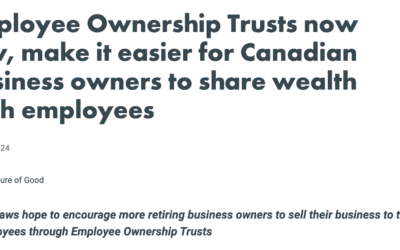
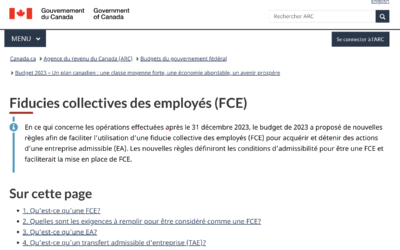
Canada’s Employee Ownership Trust legislation was passed in 2024 and includes a capital gains tax exemption of up to $10 million for qualifying sales to EOTs and worker co-operatives. The federal government has projected the fiscal cost of this incentive at approximately $80 million over the first five years, making it a targeted, low-cost intervention.
This incentive is pivotal. International experience shows that without a meaningful tax incentive, EOTs remain rare and limited to a small number of highly motivated owners. With permanent incentives, employee ownership becomes a scalable, mainstream option that delivers broad economic benefits.

GET INVOLVED
Employee ownership in Canada has advanced because individuals and organizations chose to engage. Explore membership, volunteer opportunities, and stay informed as we build a stronger, more inclusive Canadian economy.